
West Bengal’s First BJP Cabinet Meeting: Border Fencing, Ayushman Bharat and Big Governance Shifts

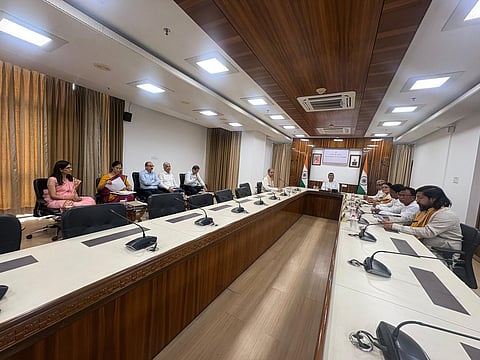
Kolkata, May 11 (TNA) West Bengal’s newly formed BJP‑led state government, under Chief Minister Suvendu Adhikari, has taken a series of high‑profile decisions in its first cabinet meeting held today at Nabanna in Kolkata, signalling a sharp policy shift from the previous TMC‑ruled administration. The meeting, which focused on security, welfare, and administrative reform, set the tone for the new “double‑engine” government’s agenda in the state.
Security and border fencing
The cabinet has approved the immediate transfer of state land to the Border Security Force (BSF) within 45 days to expedite fencing along the India‑Bangladesh border, a move framed as critical for national security and curbing illegal infiltration. Chief Minister Adhikari asserted that the earlier government had delayed the process, allowing vulnerable border areas to remain open, and promised that West Bengal will now fully cooperate with central security agencies.
Health and central welfare schemes
The state will formally join Ayushman Bharat – Pradhan Mantri Jan Arogya Yojana, rolling out the central health‑insurance scheme across West Bengal to provide cashless treatment coverage to eligible families. In addition, the cabinet decided to integrate West Bengal with other central schemes such as PM Ujjwala Yojana 3.0, PM Fasal Bima Yojana, PM Vishwakarma Yojana and Beti Bachao Beti Padhao, aiming to expand social‑welfare reach in both rural and urban areas.
Alongside these policy decisions, Adhikari’s first cabinet meeting was used as a political platform to contrast the BJP‑led administration with the outgoing regime, accusing the earlier government of obstructing central‑state coordination, delaying security measures, and sidelining national‑level schemes.
Law and governance changes
The government has announced the immediate implementation of the Bharatiya Nyaya Sanhita (BNS) in West Bengal, replacing the colonial‑era Indian Penal Code as the state’s principal criminal‑law statute. The cabinet also lifted previous restrictions that barred state IAS, IPS and WBPS officers from attending central training programmes and deputations, arguing that this will improve coordination and professional capacity in the bureaucracy.
Job and welfare measures
To address youth employment concerns, the cabinet has decided on a five‑year extension of the upper age limit for government‑job aspirants who missed recruitment cycles, a move likely to cover a large number of pending candidates.
The new government also resolved to take full responsibility for the families of 321 BJP workers whose deaths the party attributes to political violence, promising welfare support and acknowledging them as “martyrs” of the party.
Census and political messaging
The cabinet gave its nod to launching or fast‑tracking the state‑level component of the national census in West Bengal, which will be carried out in coordination with the Union government. Alongside these policy decisions, Adhikari’s first cabinet meeting was used as a political platform to contrast the BJP‑led administration with the outgoing regime, accusing the earlier government of obstructing central‑state coordination, delaying security measures, and sidelining national‑level schemes.