
Supaul In Bihar pilots climate-smart sanitation

In one of Bihar’s most flood-prone districts, where swollen rivers routinely submerge fields and homes and a high groundwater table challenges traditional sanitation systems, an innovative WASH (Water, Sanitation and Hygiene) pilot is rewriting what safe sanitation can look like.
The Supaul Model, piloted by FINISH Mondial in partnership with Gyan Seva Bharti Sansthan (GSBS), is rapidly emerging as a lighthouse initiative for climate-resilient sanitation—one that other vulnerable districts may soon emulate.
Across rural India, millions of households have adopted toilet systems such as twin leach pits, single leach pits, and septic tanks. While these technologies have contributed significantly to India’s sanitation revolution through the Swachh Bharat Mission (SBM), experts and field studies point to persistent gaps in ensuring safely managed sanitation.
Nowhere is this need more urgent than in regions like Supaul, situated in the Kosi basin, where intense rainfall, recurring floods, and shifting soil conditions undermine conventional toilet structures.
A key challenge stems from limited awareness. Studies show that many households are unsure of the sanitation technologies appropriate for their terrain and typically rely on local masons for guidance. However, as highlighted in a WaterAid study covering 52 masons, 40% were found to install vent pipes incorrectly in leach pits, while 42% were not aware of the best technologies available for high water table areas.
Such gaps lead to toilets collapsing, groundwater contamination, or pits filling rapidly during floods. In many cases, families revert to unsafe practices when their toilets fail, reversing hard-earned sanitation gains.
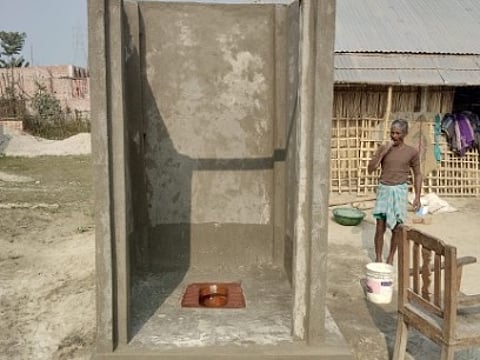
It is in this context that FINISH Mondial’s Supaul pilot is demonstrating a thoughtful and integrated solution. Designed to promote climate-smart, safely managed sanitation, the project focuses on 55 vulnerable households who face the dual threats of high groundwater levels and recurrent flooding.
The intervention combines both hardware—in the form of appropriate toilet sub-structures—and software that entail community awareness, training, and behaviour change. FINISH Mondial supports the construction of the toilet sub-structure, while households invest in building the super-structure, ensuring a sense of responsibility and ownership. GSBS leads implementation on the ground, supported by FINISH Mondial’s technical expertise and monitoring.
What makes the Supaul Model stand out is its emphasis on technologies that meet essential performance criteria: toilets must be odour-free, prevent fly and mosquito breeding, keep waste unseen and inaccessible, and most importantly, avoid contaminating groundwater, surface water, or soil. By adhering to these criteria, the model not only aligns with global norms for safely managed sanitation but also addresses the unique environmental stresses of Bihar’s floodplains.
A central innovation within the Supaul initiative is the promotion of the Phayademand Sauchalaya—a climate-resilient toilet design specifically suited for high water table and flood-prone areas. Unlike conventional leach pits that tend to overflow or leak during flooding, the Phayademand Sauchalaya is engineered to ensure safe containment even when the ground is saturated or submerged. Its design prevents effluent from escaping into the environment, thereby reducing risks of contamination of drinking water sources—a chronic challenge in the Kosi region. Additionally, the structure is built with reinforced materials and elevated components that withstand prolonged waterlogging, making it far more durable than standard rural sanitation models.
Beyond technology, the Supaul Model recognises that climate-resilient sanitation cannot succeed without strong community engagement. As part of the pilot, awareness sessions have been conducted to educate households about the risks of groundwater contamination, safe usage and maintenance of the new toilet designs, and the importance of adopting sanitation solutions suited to their terrain. Local masons are also being trained to improve their understanding of flood-resilient toilet technologies, addressing a long-standing gap in rural construction practices. This capacity-building component is crucial for scaling the model across Bihar and other flood-affected states.
As the pilot progresses, the Supaul Model is drawing attention from district authorities, development practitioners, and WASH experts who see in it a scalable pathway to climate-resilient sanitation. By merging appropriate technology with community ownership, technical training, and environmental safeguards, FINISH Mondial and GSBS are helping rural Bihar pioneer a future-ready sanitation ecosystem.
- Chander Mahadev