
New Delhi, October 28 (TNA) Official data from the National Pharmaceutical Pricing Authority (NPPA) shows substantial reductions in the maximum retail prices of several non-scheduled anti-cancer medicines, with the price of Thiotepa falling from ₹80,072 to ₹7,150 for a 100 mg vial.
The revision follows the government’s decision to rationalise trade margins for 137 non-scheduled anti-cancer formulations. Under the measure, trade margins have been capped at 30% of the maximum retail price, excluding GST.
Thiotepa Sees Sharpest Cut
Thiotepa recorded one of the steepest reductions among the medicines covered by the revised pricing exercise. Its MRP has fallen by nearly 91%, reducing the price of a 100 mg vial by around ₹72,900.
The medicine is used in cancer treatment, including in chemotherapy and conditioning regimens associated with certain procedures. The revised price is expected to reduce the cost burden for patients requiring hospital-administered treatment.
2017 MRP Issue
The pricing review has also brought renewed attention to the 2017 exposure of alleged overcharging in the sale of cancer medicines. Following the earlier MRP revisions, hospitals were accused of continuing to charge patients according to the older, higher printed prices for medicines administered within hospitals.
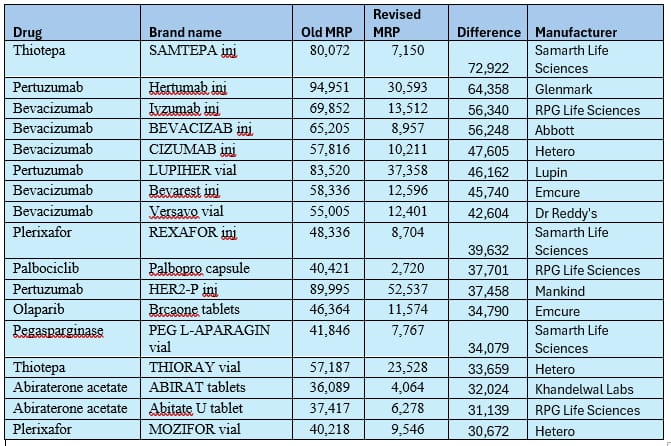
Because many of these medicines were supplied directly through hospitals, patients often had limited ability to compare prices or purchase the drugs independently. The latest NPPA data provides a revised benchmark for hospitals, pharmacies and patients.
137 Drugs Covered
The trade-margin cap applies to 137 non-scheduled anti-cancer formulations, including patented and non-patented medicines. The list includes drugs such as nivolumab, olaparib, denosumab, topotecan, abiraterone, dasatinib, erlotinib, azacitidine and pegfilgrastim.
The government expects the measure to reduce retail prices by up to 70% in some cases, although the actual reduction varies according to the existing price structure, manufacturer, strength and dosage form. The 30% cap is a limit on the trade margin and does not mean that every medicine’s MRP will automatically fall by 30%.
Revised Rates From November 9
The revised prices are scheduled to take effect from November 9, 2026. The NPPA has said that pharmaceutical companies must publish updated price lists and circulate them among retailers and hospitals.
The latest data covers 543 formulations across the 137 selected drugs. While several medicines have seen significant reductions, some formulations have recorded little or no change, highlighting differences in pricing structures across brands and products.
The latest data covers 543 formulations across the 137 selected drugs. While several medicines have seen significant reductions, some formulations have recorded little or no change, highlighting differences in pricing structures across brands and products.
Patients and healthcare providers will be able to verify the revised rates through the NPPA website and the government’s “Pharma Sahi Daam” mobile application. Hospitals and pharmacies will be expected to display and charge the updated MRPs once the new prices come into force.